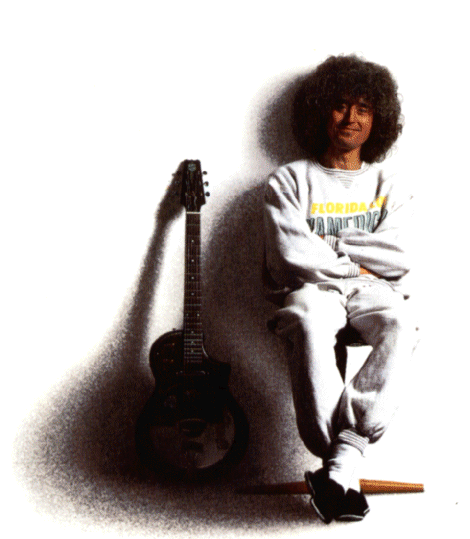
AB: Not, it is not that. Me I do not put myself the question. I was never frustrated, in this direction there. **time-out** I me be recover to study, it there have a few year, because I want envie nevertheless to know a little bit more, of composition, of direction of orchestra and all that, which me have pose not badly some problem, because obviously, you tomb in a universe where your certainty, - I want say, already, aprés the first lesson, you you realize that if you know ten way to harmonize that, actually it there of have hundred thousand Then, hiu... You digest that too.
NC: And in time that musician, you do like to make meetings with other musicians?
AB: Oh yes.
NC: Because what I find frustrating, for we who are not musicians, it is that one is opposite people who have a universal language.
AB: Yes, me I knew many musicians, I played with many people, and even with the large ones: there is Stephen Stills, I am very friendly of him, I played even with groups which you would not imagine, of music hard rock or progressive music, or anything, it is that the beauty, " jams ". It is that which it is necessary, " hiu-hiu ", démerder. But me, two weeks ago, when I was in Latin America, I found people who played, me I did not believe. Then there... You go there!
-
Triumph over strange softness, Etienne RODA-GIL the words, Angelo BRANDUARDI the music and the voice... It emerges in the Seventies with songs with the new, " médiévalo-pop " taste, it surprises, it is him. And Etienne RODA-GIL, the star author of the French song, joins him to adapt the words of its stroll. Together, they create a universe completely different from all that one listens to, and in 1974, Angelo BRANDUARDI makes an input noticed in what one calls " the new French song ". Twenty-two years later, always present and inventive, Branduardi returns, with an album, the " threat ", and a series in concerts which threatens to shake the young public which never saw that... The attentive listener will immediately recognize the leg of the Master and the musical colors of BRANDUARDI...
-
NC: When you introduced instruments which, for the time, were odd, into your songs, it was what, it was a will like that, a little, to surprise?
AB: Not, it was the same thing as what I said to the beginning. When I speak about the sound which arrived before all the remainder. The sound arrives before the melody, that the rate/rhythm, before the words, before all. And besides, it is even at the technical level, it is the capability and the talent of a producer too. Then the sound, because the sound, it is a primitive thing, therefore that will touch things which are not parameters that you had, of the history, but they are direct things, i.e., very hidden. Then a primitive sound has possibilities of doing much evil much of evil or much of good. And in the same way, a highly technological sound has these same capacities. Thus, paradoxically...
NC: Of evil and good with the others, with those which receive it?
AB: Yes, and paradoxically, the primitive music is much closer to the technological music hyper than one believes.
NC: Because of the rhythmic one?
AB: Not, because of the sound. Worship of the sound.
NC: But precisely, I would like that one speaks a little, finally if you want, about the responsibility for the artiste:Il has a capacity there, on the world...
AB: But not. Me, I never regarded that as that. I know, it is an important speech, which one much time made, but, you see, me I do not consider... I.e., me I do that, - ah yes, forgiveness, I go in the other room me I do that, if you want you like it, if you want you are ready with the rejetter. Yes, they are not subliminal messages.
NC: Subliminal?
AB: But not. You can say very well that that does not interest you!
NC: Then, in the phenomenon of the artist, there is also another parameter, of which would be needed that one speaks, it is the posterity.